How to Read a Pesticide Label Before You Spray Something You’ll Regret
You wouldn’t assume that a gun was safe without going through safety checks to ensure that bringing it into your home wasn’t going to put everyone in danger.
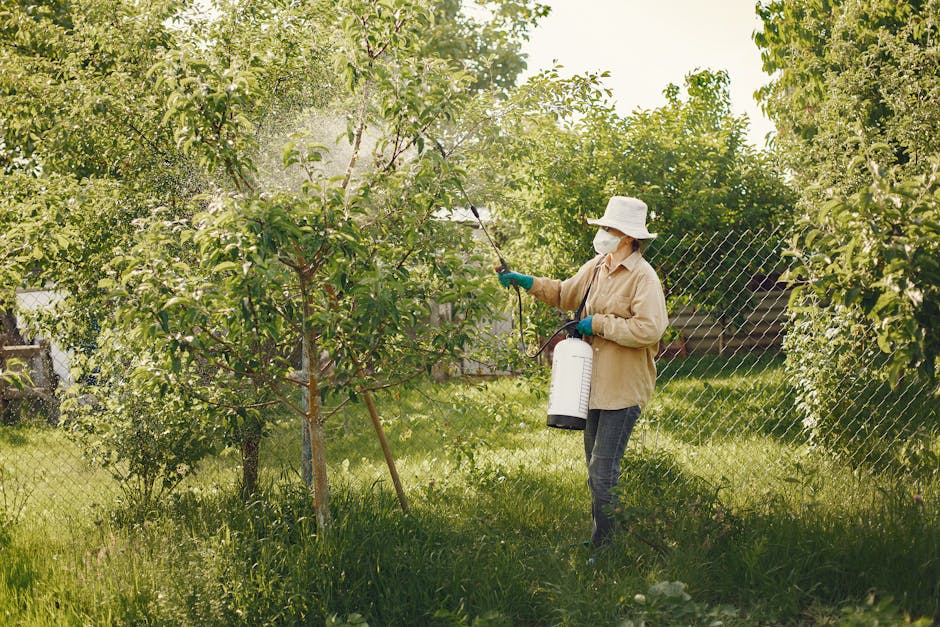
Picking up a pesticide with the intent of using it around your house, property, or business without reading and understanding the pesticide label — you are assuming that the chemical equivalent of the gun is safe without the facts to back it up. Maybe it works out. Maybe it doesn’t. But do you really want to put your life and the lives of your loved ones in harm’s way?
And when it comes to chemicals, assuming is a bad habit.
Luckily, it is a bad habit that can be changed with just a little bit of attention to information that is readily available and simple to use and acquire.
The information has an added benefit — it also ensures you get the best results from it because you find out if it’s effective against what you planned to use it on.
The good news? You don’t have to be a chemist or licensed technician. You just need to know what information you need and where to find it. Anyone looking to use pesticides to solve a pest problem must follow the product label that accompanies all pesticides.
The EPA says pesticide labels are legally enforceable and carry the statement that it is a violation of federal law to use the product in a way that does not match the labeling. In plain English, when you use a pesticide you must realize that the label is not just advice. It is the rule book.
So let’s make that rule book easier to read.
[ ]
]
Why You Should Care
If you’re buying a pest product yourself, the label tells you whether it is even meant for the bug you have, whether you can use it indoors, how much to use, what to wear, and how long people or pets should stay out of the area.
If you hire a pest control company, the label tells you what questions to ask. Not because you’re trying to be difficult. Because it’s your house. Your tenants. Your building. Your people.
Think of the label like the instructions on a chainsaw. You don’t need a lecture. You just need the part that keeps you from doing something dumb.
The Most Important Thing on the Label
You’ll usually see a sentence like this somewhere on the label:
It is a violation of federal law to use this product in a manner inconsistent with its labeling.
That sounds stiff. Here’s what it really means.
- If the label says it’s for outdoor perimeter use, you can’t spray it all over your kitchen floor.
- If the label says it works on ants and roaches, you can’t assume it’s fine for bed bugs.
- If the label says mix 1 ounce per gallon, you don’t get to decide 4 ounces per gallon will “really knock them out.”
- If the label says keep people out of the area for a certain amount of time, that’s not optional.
That one sentence is the backbone of the whole label.
Start Here: The Parts That Matter Most
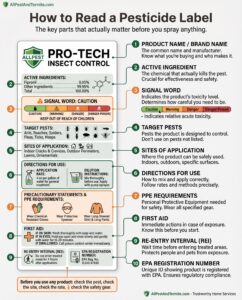
If you’re not a licensed applicator, these are the parts you must pay attention to first.
| Label Section | Why Regular People Should Care |
|---|---|
| Product name | Makes sure you’re looking at the right product |
| Active ingredients | Tells you what’s actually doing the work |
| Signal word | Gives you a quick hazard warning |
| Target pests | Tells you whether it’s even meant for your problem |
| Sites of application | Tells you where you can legally use it |
| Directions for use | Tells you how much to use and how to apply it |
| PPE requirements | Tells you what to wear |
| Re-entry interval | Tells you when people can go back in |
| First aid | Tells you what to do if something goes wrong |
If you read those carefully, you’ll avoid most of the common mistakes people make.
Product Name and Brand Name
This sounds basic, but it matters. The product name tells you what you’re holding. That helps you make sure you’re reading the right label and not something that just sounds close.
A lot of products have similar names. One might be a ready-to-use spray. Another might be a concentrate. One may be for outdoor use only. Another might be approved for certain indoor uses.
Don’t trust memory. Match the label to the exact product in your hand.
Active Ingredients and Percentage
This section tells you what chemical is actually doing the pest-killing work.
Think of it like this. The brand name is the truck paint. The active ingredient is the engine.
You’ll usually see the active ingredient listed with a percentage. That percentage tells you how much of the product is made up of that chemical.
Why should you care?
Because two different bottles can look similar and still have different active ingredients or different strengths. That can change how they’re used, what pests they’re for, and what precautions matter.
If you hire a pest company, asking for the active ingredient is a smart question. It tells you more than the marketing name ever will.
Signal Word: Caution, Warning, Danger, and Danger-Poison
This is one of the first things I’d look at.
The signal word gives you a quick sense of the product’s short-term hazard level. The EPA and pesticide safety sources use signal words like Caution, Warning, and Danger, and the most highly acutely toxic products may carry Danger-Poison with a skull and crossbones.
Here’s the plain-English version.
| Signal Word | What It Means in Normal Human Language |
|---|---|
| Caution | Lower acute hazard than the others, but still not harmless |
| Warning | More serious than Caution |
| Danger | High immediate hazard, such as severe irritation or worse |
| Danger-Poison | Very highly toxic by acute exposure |
The mistake people make is seeing Caution and thinking it means safe. It doesn’t. It just means lower on the immediate hazard scale than Warning or Danger.
A product with a stronger signal word deserves more respect. More care. Better protection. Less freelancing.
Precautionary Statements
This is where the label spells out the main safety warnings.
It may include hazards to humans, domestic animals, the environment, and sometimes physical or chemical hazards.
If the label says avoid contact with skin or eyes, avoid breathing spray mist, keep away from children, or do not contaminate water — that is the section doing the talking.
Think of it as the “don’t get careless” section.
This matters to regular people because it translates the chemical risk into everyday behavior. Wear gloves. Wash up after use. Keep pets out. Don’t spray near fish tanks. Don’t use it where food is exposed. Basic stuff, but important.
First Aid or Statement of Practical Treatment
This section tells you what to do if the product gets on somebody, in somebody, or around somebody the wrong way.
That may mean eye rinsing, skin washing, moving to fresh air, or calling a poison center or doctor.
Here’s the rule. Read this part before you use the product.
Nobody wants to be standing in a kitchen with burning eyes trying to unfold a wet label while panic-reading tiny print.
Target Pests: This Product Is Not for Everything
This is one of the biggest ones.
The target pests section tells you what the product is actually approved to control.
If the label says ants, roaches, and silverfish, that does not mean it’s fine for termites, fleas, or bed bugs.
That sounds obvious. But people do this all the time. They assume bug spray is bug spray.
It isn’t.
Think of it like medicine. You wouldn’t use cough syrup for a broken ankle just because both problems involve a human body. Same idea here. Wrong product, wrong target, wrong result.
If you’re hiring a pest guy, ask him this simple question: Is this product actually labeled for the pest you say I have?
That’s not a rude question. It’s a smart one.
Sites of Application: Where Can This Be Used?
This section tells you where the product can legally be used. That may include indoors, outdoors, around foundations, in cracks and crevices, on lawns, in certain commercial settings, or in food-handling areas under specific conditions.
This is where people get in trouble.
A product may be fine around the outside of a building but not okay for broad indoor use. A product may be allowed in a commercial kitchen only in very specific ways. A product may be okay on ornamental plants but not on vegetables.
In plain English, if the label does not allow that site, don’t use it there.
Directions for Use: The Recipe That Actually Matters
This is probably the most important section on the whole label for somebody doing the application.
The directions tell you how much to use, how to mix it, how to apply it, how often you can reapply it, and what limits you need to follow.
Think of it like a recipe. If the recipe says one cup of rice and two cups of water, dumping in four cups of water because you feel creative is not going to improve dinner.
Same thing here.
Application Rates
The label may tell you to use a certain amount per gallon, per square foot, per linear foot, or per area.
That rate matters.
Too much can be unsafe, illegal, and messy. Too little may not work.
Dilution Ratios
If the product is a concentrate, the label will tell you how to mix it.
Follow that exactly.
Not close. Not “about right.” Exactly.
Application Methods
The label may allow crack-and-crevice use, spot treatment, perimeter treatment, broadcast application, bait placement, or other specific methods.
That matters because one method may be allowed while another is not.
A real example? If a product is labeled for cracks and crevices, that does not mean you can hose down the whole pantry with it because you saw one roach.
| What to Check in the Directions | Why It Matters |
|---|---|
| Mixing rate | Keeps you from making it too strong or too weak |
| Treatment site | Keeps use legal and sensible |
| Application method | Prevents misuse |
| Reapplication limits | Keeps you from overdoing it |
| Special restrictions | Helps avoid contamination and drift |
PPE Requirements: What Should Be on Your Body, Not Just in Your Hand
This section tells you what personal protective equipment, or PPE, is required or recommended for safe use.
That may include gloves, long sleeves, eye protection, closed shoes, or more specialized gear depending on the product.
If you’re using the product yourself, don’t treat PPE like overkill. It’s there because the chemical doesn’t care whether you’re a professional or a guy in gym shorts trying to handle a wasp problem on Saturday.
If you’re hiring somebody, PPE tells you something about whether the work is being done seriously.
If the label and product call for gloves and eye protection, and the applicator looks like he came straight from mowing the lawn, pay attention.
Re-entry Interval (REI): When Can People Go Back In?
The re-entry interval, or REI, tells you how long people need to stay out of a treated area before going back in without special protection.
This matters a lot in places with kids, pets, tenants, employees, or customers.
Think of it like wet concrete. Just because the job is done doesn’t mean it’s ready to be walked on.
Some products may have no meaningful waiting time for the kind of household use you’re dealing with. Others may have specific restrictions, especially in agricultural or more heavily regulated settings.
The simple question is this: When is it okay for normal people to go back into that space?
If you’re hiring a pest company, ask that directly.
Pre-harvest Interval (PHI): Mostly for Crops, Not Kitchens
The pre-harvest interval, or PHI, matters mostly for agricultural products. It tells you how long to wait between treatment and harvest.
If you’re just dealing with household pests, you probably won’t spend much time here.
But if you’re managing grounds, gardens, or anything edible, this section matters. You do not want to guess when it comes to food crops.
Storage and Disposal
This is the “what do I do with the leftovers?” section. It tells you how to store the product safely and how to dispose of the product or container the right way.
That matters more than people think.
Leaving half-used products in a hot garage, next to pet food, under a kitchen sink, or in reach of kids is not smart. Neither is pouring leftovers down a drain because you want the bottle gone.
Read the storage and disposal instructions. They are there for a reason.
EPA Registration Number and EPA Establishment Number
These are the product’s official ID numbers.
The EPA registration number identifies the registered product.
The EPA establishment number identifies where it was produced or packaged.
Most regular people won’t use these every day, but they matter when you want to confirm exactly what product you have or when you need to track down more information.
Manufacturer Info and Net Contents
These are the simpler parts.
The manufacturer section tells you who made or sold the product and how to contact them.
The net contents tell you how much product is in the container.
Not the sexiest information in the world. Still useful.
Questions to Ask Your Pest Control Company
If somebody is coming to your house or building with a tank, hose, or sprayer, here are the questions worth asking.
| Ask This | Why It Matters |
|---|---|
| What product are you using? | So you know exactly what’s being applied |
| Is it labeled for the pest you found? | Confirms it fits the problem |
| Is it labeled for indoor use, outdoor use, or both? | Confirms the site is allowed |
| Do I need to leave the area, and for how long? | Helps protect people and pets |
| Are there any surfaces I should avoid touching afterward? | Helps you use the space safely |
| Can you send me the product label and SDS? | Gives you the basic paperwork to review |
That’s not being difficult. That’s called paying attention.
What to Check Before You Spray Anything in Your Kitchen
If you bought a product and you’re thinking about using it in the kitchen, slow down and check a few things.
Make sure the pest you have is actually on the label. Make sure indoor use is allowed. Make sure the application method matches what you’re about to do. Read the first aid section. Check the PPE. And make sure you know whether food, dishes, prep surfaces, kids, or pets need to be kept out of the way.
This is not the place for freestyle pest control.
Final Word
Look, I’m not saying every label is easy to read. A lot of them are a mess.
But if someone’s spraying chemicals in your house, or if you’re about to do it yourself, you should know what’s in the bottle, what it’s for, where it can be used, and what the rules are.
That’s not overreacting. That’s common sense.
Read the parts that matter. Ask questions when something feels off. And don’t let anybody brush you off with “it’s fine” when the label says otherwise.
And before you buy a product or book a treatment, make sure you actually know what pest you’re dealing with in the first place.
Not sure what you’re dealing with? Use our free Pest ID tool before you reach for any product.
Not Sure What Bug You Found?
Upload a photo to our free AI Pest Identifier. Get an instant ID and step-by-step treatment plan — no account required.
❓ Frequently Asked Questions
What information should I look for on a pesticide label?
When reading a pesticide label, focus on the active ingredients, usage instructions, safety precautions, and first aid measures. This information will help you understand how to use the product safely and effectively.
How can I determine if a pesticide is safe for my home?
To determine if a pesticide is safe for your home, check for any specific safety warnings on the label, such as restrictions for pets or children. Additionally, look for any certifications or approvals from regulatory agencies that indicate the product’s safety for residential use.
What does the term ‘signal word’ mean on a pesticide label?
The signal word on a pesticide label indicates the level of toxicity of the product. Common signal words include ‘Caution’ for low toxicity, ‘Warning’ for moderate toxicity, and ‘Danger’ for high toxicity. Understanding this can help you gauge the risks involved before using the product.
How to read a pesticide label before you spray something you’ll regret?
To read a pesticide label effectively, start by understanding the purpose of the product and follow the usage instructions carefully. Pay attention to the recommended application rates and any safety precautions to avoid unintended consequences.
What should I do if I accidentally spray too much pesticide?
If you accidentally spray too much pesticide, immediately follow the first aid instructions on the label. Ensure proper ventilation and avoid contact with the area until it is safe to do so. If symptoms arise or you’re unsure, contact a poison control center for guidance.
Not ready to call? Get free competitive quotes.
Compare top-rated local pest control pros — it’s free.
Related Reading
🔍 Dealing with a pest problem? Get a free AI identification →
Not Sure What Bug You Found?
Upload a photo to our free AI Pest Identifier. Get an instant ID, severity rating, and step-by-step treatment plan — no account required.
🔍 Identify My Pest Free →